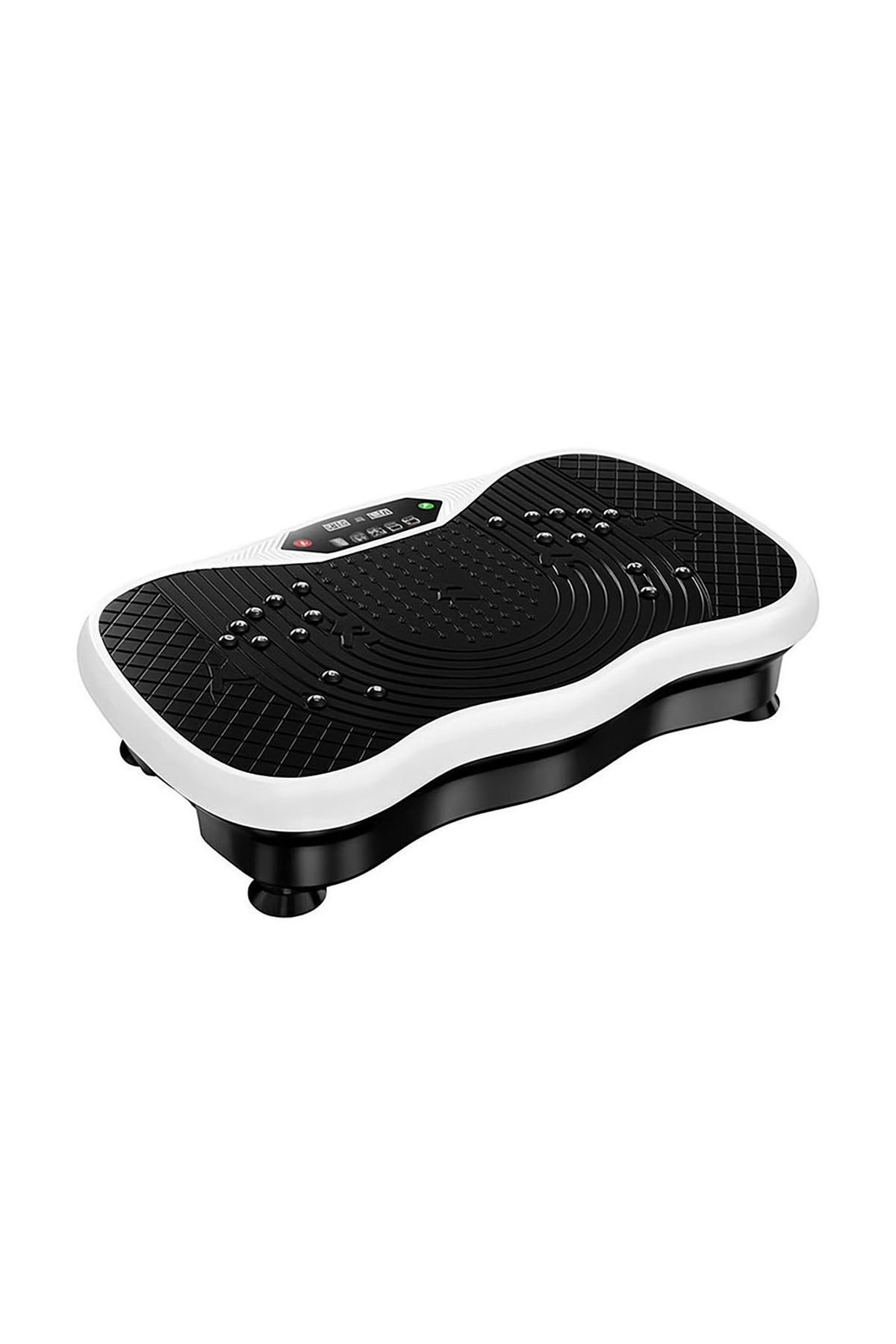
Let's start with an honest answer: standing on a vibration exercise platform does not replace running or lifting weights. The statement "lose weight by doing nothing for 10 minutes a day" is incorrect. However, there are several clear situations where these devices really work and provide measurable benefits. In this article, we explain what to expect, what not to expect, and how to use the device truly effectively.
How does it work?
When the platform vibrates dozens of times per second, your body makes constant small adjustments to maintain balance. These adjustments are not conscious; the muscles contract and relax involuntarily. So, even though you may appear to be standing still, the leg, hip, and core muscles are working. This is called "whole-body vibration" and has been used in physical therapy for a long time.
The key point here is this: muscle activation is real, but energy expenditure is limited. The muscles work, blood circulation increases, but the calories burned are lower than those of a brisk walk. The function of the device is not to replace cardio, but to complement it.
Realistic expectations: what is it good for?
- Blood circulation and a feeling of leg heaviness. This is the effect that people who sit at a desk all day notice the most; after a few minutes, there is a noticeable relief in the legs.
- Muscle relaxation and recovery. Using it at a low setting after a workout helps reduce stiffness.
- Balance and muscle control. This is the topic with the most support in the literature, especially regarding its contribution to balance training in sedentary and elderly users.
- Lowering the threshold to start exercising. It should not be underestimated: for someone who does not go to the gym, having the gym come to their feet can be decisive for consistency.
- When combined with resistance bands and positions, it can turn into a real strength workout. This is where the real benefit lies — we explain it below.
What is it not good for?
- Spot fat burning. The body does not burn fat by selecting it from the vibrating area. There is no device or program focused on the abdominal area — if anyone has one, it is not scientific, but a marketing claim.
- Losing weight without a calorie deficit. Without changing your diet, no device will make you lose weight.
- Cardiovascular endurance. For heart-lung capacity, walking, running, or cycling is required; a vibration platform does not replace this.
- Cellulite treatment. The skin appearance may temporarily improve, but it is not a permanent treatment.
The thing that triples efficiency: not standing upright on it
The majority of people who buy the device stand on it and stand perfectly still, and after a few weeks say "nothing is happening." They are right — because standing upright is the position where the vibration does the least work. The thing that determines the effect is position:
- Half squat (knees slightly bent) — the most basic and effective position. When the knees are bent, the muscles have to absorb the vibration; in an upright position, the vibration travels directly up the skeleton.
- Standing on one foot — balance training, activates the core muscles.
- Placing hands on the platform in a plank / push-up position — upper body and abs.
- Sitting on the platform with feet on the ground — massage effect, leg circulation.
- Arm exercises with resistance bands — this is why our FG-1000 and FG-6500 models have upper body resistance bands; this is the part that turns the device from a lower body machine into a full-body machine.
Practical rule: knees should always be slightly bent. Standing with locked knees causes the vibration to travel to the spine and head and can cause dizziness.
Duration, setting, and program
On these devices, "longer" is not better. A typical start is set up as follows:
- First week: 5–10 minutes a day, low setting. The body needs to get used to it.
- Afterwards: 10–20 minutes, 3–5 days a week. On the FG-1000, the duration is already set between 1–20 minutes; this is not an arbitrary limit but a reasonable upper limit.
- Low settings for relaxation, circulation, and massage; medium settings for general exercise; high settings are used for short-term intense activation. The FG-962's 99 settings are divided into this purpose into three zones (1–30 / 30–60 / 60–99).
Preset programs (P00–P09 on the FG-962, P1–P5 on the FG-6500, P1–P3 on the FG-1000) change the speed in a specific rhythm — meaning you don't have to deal with the setting, and the device applies a wavy pace. For beginners, not having to deal with choosing a setting increases consistency; as you gain experience, manual mode is more controlled.
Remote control and speaker: not unnecessary
Bending over to reach the panel while on the platform disrupts both balance and the position. The remote control is directly related to efficiency because it allows you to change the speed without leaving the position. The Bluetooth speaker (FG-963, FG-1000, FG-6500), while it may look like a fancy add-on, follows the same logic: spending 15 minutes with music is the cheapest way to increase consistency.
When choosing a device
- Carrying capacity — look for a limit at least 20 kg above your own weight. The FG-963 carries 120 kg, the FG-6500 carries 150 kg.
- Number of settings — the difference between 99 or 120 settings is small in practice; what matters is that the low settings are truly soft and gentle. For beginners, precise lower settings are more valuable than a high peak speed.
- Does it have resistance bands? — if you want to work the upper body as well, this can be a deciding factor on its own.
- Surface — place the device on a flat and solid surface, and put a mat underneath. On a rug, the vibration is dampened and the device can walk.
Who should not use it?
Vibration puts a mechanical load on the body. In the following situations be sure to consult a doctor before using it:
- Pregnancy
- Pacemaker or implanted medical device
- Advanced osteoporosis, new fracture, prosthetic joint
- Deep vein thrombosis or serious vascular disease
- Gallbladder or kidney stones
- Recent surgery, hernia
- Retinal issues, frequent dizziness, epilepsy
Also: children should not use the device without adult supervision, should not jump on the device, and should not work on high settings with a full stomach.
Conclusion
A vibration exercise platform is not a magic weight-loss tool, but it is not a useless toy either. For someone who stands with bent knees, uses resistance bands, and sets aside 15 minutes 3–5 days a week, it makes a real contribution in terms of circulation, muscle tone, and balance. For someone who stands upright on it and watches television — let's be honest — not much changes. When buying the device al, the real question to ask is not "how many settings does it have," "will I use it regularly".