Short answer: yes, it works — but there are three conditions. The device must be the right capacity for your room , the filter must be changed on time, and the window must be closed . If any of these three are missing, even the most expensive device turns into an expensive fan . Below, we explain which number you should look at and why, using the values of our own devices as a guide.
What is HEPA, and what does "H13" mean?
HEPA is not a brand, but a filter class. In Europe, it is defined by the EN 1822 standard and numbered from H10 to H14. The higher the number, the higher the filter's particle capture rate:
- H11 — 95% efficiency at the most difficult particle size
- H12 — 99.5%
- H13 — 99.95% (top class for home devices)
- H14 — 99.995% (operating room, clean room)
The 99.97% figure you often see in product descriptions is the American standard measured for particles of 0.3 microns in size. Both are correct, they are just measured at different particle sizes. The practical result for home use is: Don't go below H13. If a device only says "HEPA filter" but doesn't list the class, it probably uses H11.
Why does everyone talk about 0.3 microns?
It seems counterintuitive, but the most difficult particle for filters is not the smallest particle. Particles in the range of approximately 0.1–0.3 microns are the hardest to get stuck in the filter fibers; this range is called MPPS (most penetrating particle size). Larger ones bounce off, while smaller ones stick to the fibers by zigzagging through the air (Brownian motion). So, if a filter captures 99.97% at 0.3 microns, it means it captures even better at 0.05 microns and 1 micron. Standards deliberately measure at the most difficult point.
The number you should really look at: CADR
The filter class tells you "how well it filters," while CADR tells you "how much air it filters per hour." The unit is m³/hour. A device with a perfect filter but low CADR will be useless in a large living room — because it cannot circulate the air in the room fast enough .
A simple calculation is enough:
Required CADR = Room area (m²) × 2.5 (ceiling height) × Target air exchange
The target air exchange (how many times the air in the room needs to pass through the filter completely per hour ) varies depending on the purpose of use:
- 2 times per hour — general freshness, odor, and dust control
- 4–5 times per hour — allergy, asthma, pets, pollen season
Example: In a 15 m² bedroom, if your target for allergies is 5 exchanges per hour, you need a CADR of 15 × 2.5 × 5 = 187 m³/hour.
Note here: manufacturers' coverage area values like "up to 50 m²" are generally given based on the assumption of 2 air exchanges per hour. If you have allergies, divide the square footage on the box by two or go up to the next model. This is the most common purchasing mistake.
How many filter layers are needed?
"3-layer," "4-layer" terms are not marketing fluff; each layer has a separate job, and one cannot replace the other.
- Pre-filter — hair, fur, coarse dust. Its job is to protect the HEPA; otherwise, the expensive HEPA filter will clog early.
- Electrostatic cotton — attracts fine dust and airborne pet fur with static electricity. It makes a serious difference if you have a cat/dog.
- H13 HEPA — pollen, PM2.5, mold spores, bacteria. The heart of the matter.
- Activated carbon — odors and gases. Don't skip this: HEPA filters do not capture gas molecules. Cooking odors, cigarette smoke, and volatile organic compounds (VOCs) released from new furniture are only removed by the carbon layer.
So, the answer to the complaint "the cigarette smell doesn't go away" is often not in the HEPA, but in the carbon layer being saturated.
In what situations does it not work?
Let's be honest — there are things the air purifier cannot solve:
- When the window is open. The device works in a closed volume. In a room that is constantly ventilated, the CADR calculation loses its meaning.
- With dampness and mold problems. It captures mold spores in the air, but it does not kill the mold on the wall. Solve the moisture source first.
- When the filter is not changed. A clogged filter reduces airflow; CADR drops, the device gets louder, and electricity consumption increases.
- In the wrong location. A device squeezed against the wall or hidden behind a curtain cannot draw in the air. Leave at least 30 cm of space on all sides.
- In ozone-producing devices. Some products labeled "ionizer" or "ozone generator" chemically alter pollution instead of filtering it and release ozone, which can irritate the respiratory tract. Fan-based devices with filters do not carry this risk.
When should the filter be changed?
In Fegel models, the filter life is on average 6–8 months (approximately 1500 hours) and there is a filter life tracking indicator on the device screen — you don't need to guess. However, this time shortens depending on the environment: if people smoke in the house, if there are pets, or if you live on a busy street, you may need to change it earlier.
Cleaning the pre-filter with a vacuum cleaner every 2–3 weeks significantly extends the life of the HEPA layer. The HEPA and carbon layers are not washable — contact with water destroys the structure of the HEPA fibers, and once the carbon is saturated, it cannot be restored by washing.
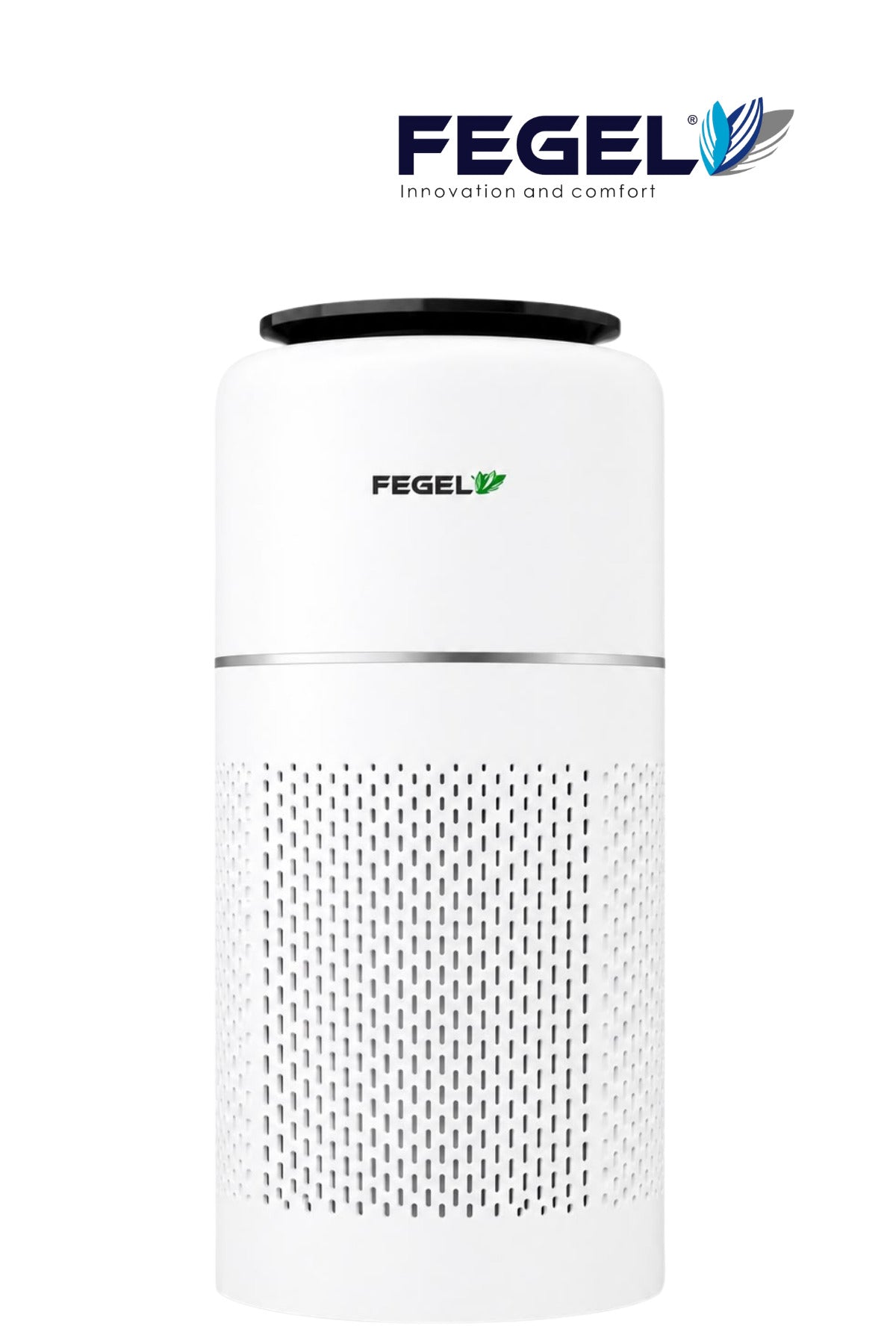
Fegel air purifier model comparison
| Feature | FG-M03N | FG-201 | FG-202 |
|---|---|---|---|
| CADR | 185 m³/hour | 330 m³/hour | 290 m³/hour |
| Coverage area | Up to 30 m² | 40–50 m² | 40–50 m² |
| Filter layers | 3 layers | 3 layers | 4 layers (with added electrostatic cotton) |
| Noise level | 35 dB (sleep mode) | ≤ 33 dB | ≤ 33 dB |
| Power | 30W | 30W | 36W |
| PM2.5 sensor | — | Yes (laser) | Yes (laser) |
| WiFi / Tuya | Yes | Yes | Yes |
| Distinguishing feature | Aromatherapy + night light | Highest CADR | Special layer for pet fur |
| Dimensions / weight | 37 × 19 cm | 50 × 26 cm / 3.6 kg | 52.3 × 27.2 cm / 4.5 kg |
Which one is right for you?
- Bedroom, children's room, study (15–20 m²): FG-M03N is sufficient. 185 m³/hour CADR means 5 air exchanges per hour in a 15 m² room — the target level for allergies. The aromatherapy compartment and night light are also designed for the bedroom.
- Living room or open-plan living area (25–35 m²): FG-201. With 330 m³/hour, it is the most powerful model in the series; it provides 5 exchanges per hour in a 25 m² living room. Thanks to the PM2.5 laser sensor, it automatically adjusts the fan speed in automatic mode.
- If you have pets: FG-202. Its CADR is slightly lower than the FG-201, but the electrostatic cotton layer captures airborne fur earlier; this extends the life of the HEPA filter. In a home with a cat/dog owner, this layer is more useful than the raw CADR difference.
Original replacement filters for all three models are in stock: FG-201 filter, FG-202 filter, and FG-M03N filter. You can review all models in the air purifier category.
Frequently asked questions
Should the air purifier stay on 24/7?
Ideally, yes. The moment the device is turned off, the room starts getting dirty again; particles are constantly added to the environment from walls, textiles, and outside. In automatic mode, the device already operates at a low speed and uses little electricity in clean air — about 30W, like an average light bulb.
Which room should I put it in?
The room where you spend the most time each day. For most people, this is the bedroom: you spend about one-third of the day there, and you do so while breathing deeply. Do not place the device right next to the bed, but at a point in the room where air circulation is easy.
Will it completely eliminate my allergies?
No, it "won't eliminate" them — but it significantly reduces the load of pollen, dust mites, and pet allergens in the air. Allergy management is a multi-component task: washing bed linens at 60 °C, cleaning rugs and curtains, and keeping the humidity below 50% are just as important as the device.
Can I wash the filter and reuse it?
Yes for the pre-filter, you can clean it with a vacuum cleaner or rinse it. No for the HEPA and activated carbon layers — water destroys the structure of the HEPA fibers, and carbon cannot be restored by washing once it is saturated.
Is the device loud?
In sleep mode, the FG-201 and FG-202 are at ≤ 33 dB, while the FG-M03N is at 35 dB. For comparison: a whisper is approximately 30 dB, a quiet library is 40 dB. At the highest speed, it naturally operates louder; the most efficient way is to use this mode for 15–20 minutes when you enter the house and then switch to automatic mode.
All Fegel air purifiers come with a 2-year official distributor warranty. If you are unsure about model selection, write us the square footage of your room and whether you have pets at home, and we will determine the right model together.