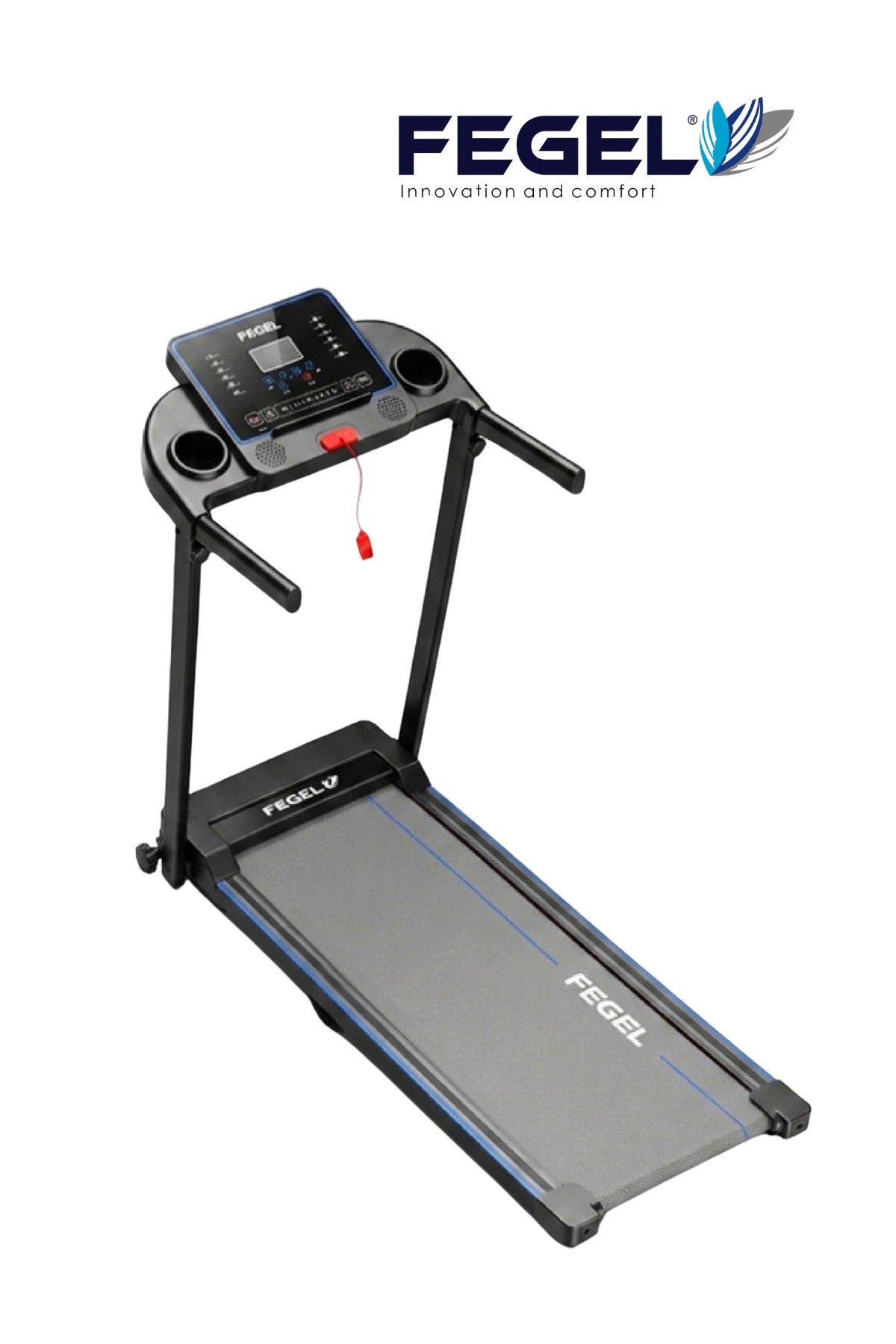
When choosing a treadmill, most people first look at the speed range — but on a treadmill used at home speed is the lowest priority. On a device that says 16 km/h you will never reach 16 km/h in your life. There are three main factors that really matter: the motor's continuous power, the length of the running area, and the device's weight capacity. Below, we explain these three and a few overlooked details using the actual specifications of our own models.
1. Motor power: not every number labeled "HP" is the same
Treadmill motors are labeled in two different ways, and the difference is significant:
- Peak HP (peak power) — the maximum the motor can reach for a moment. This number is used in marketing because it is larger.
- Continuous HP (continuous power / CHP) — the power the motor can produce for hours without causing problems. This is what matters to you.
If a product only says "3.0 HP" but does not specify which one, it is almost always peak power. When comparing, look at the same type of value for both devices, otherwise you will be comparing apples and oranges.
Practical thresholds:
- 0.75–1.0 continuous HP — walking and light pace. The typical range for home walking pads.
- 1.5 HP — regular walking + occasional light running. The vast majority of home use falls into this category.
- 2.0 continuous HP and above — users over 90 kg, daily actual running, or multiple people using it at home.
An example from our range: the motors of the FG-380HT, FG-04, FG-07, FG-09, and FG-11 models are 1.5 HP; the FG-12 is rated at 0.75 HP continuous power — meaning this number, which looks smaller on paper, is a more honest value than many devices labeled "peak power".
User weight directly affects the motor
Weight capacity is not a "breaking point", but an operating limit that determines the lifespan of the motor and the belt. It is ideal for your weight to be below 80% of the capacity. Using a device with a 100 kg capacity with 98 kg every day means operating the device constantly at its limit.
The values in our range: FG-11 100 kg; FG-04, FG-07, FG-09, FG-13 and FG-380HT 110 kg. So for a 95 kg user the FG-11 is not the right choice, but models in the 110 kg class are.
2. Running area: directly related to length
This is the source of the most common mistake. The width of the running area is a matter of comfort, length is a matter of safety. If your stride length does not fit on the belt you will either shorten your stride (unnatural walking, knee strain) or step off the back end of the belt.
A rough rule:
Walking only: A belt length of 100–110 cm is sufficient.
Light running (8–10 km/h): at least 110–120 cm.
Over 1.85 m tall or actual running: look for 130 cm or more.
Examples: FG-11 980 × 385 mm (walking-focused), FG-04 1050 × 385 mm, FG-13 1050 × 385 mm. These dimensions are designed for walking and light pace; if you are tall or will run regularly look for a model with a longer belt.
Is 38.5 cm too narrow?
It is not narrow, but it is not "tolerant" either. If you are used to 50 cm wide belts in gyms, you will need to consciously stay in the middle during the first few days. In return, a narrow belt significantly reduces the space the device takes up at home — a matter of preference.
3. Incline: automatic, manual, or none?
Incline is the healthiest way to increase intensity without increasing speed. Walking at 5 km/h at a 5% incline provides calorie burning close to running at 7–8 km/h on flat ground, but the impact on the knees and ankles is much less. For users with joint problems or those who want to lose weight, incline is more valuable than speed.
- Manual incline — changed with the pin/foot adjustment while the device is stopped. It is cheap and mechanically sturdy; the disadvantage is that you cannot change it during a workout. The FG-09 has 5% (50 mm) single-step, the FG-12 has 3-step manual incline adjusted with a steel pin.
- Automatic incline — changed from the panel while running. Necessary for interval workouts and app-supported routes; the motorized mechanism increases the price and weight of the device.
- No incline — if you will only walk on flat ground, it is not a problem, you will have avoided unnecessary costs.
4 overlooked details that determine daily use
Folding method
"Foldable" does not mean just one thing. In some models only the belt goes up, in others the post also lies down. In the FG-10, the support column can be laid down over the body, so the device becomes thin enough to fit under a table or bed. In the FG-10, this is also a safety feature: when the column is folded, the device automatically switches to "Walking Mode" and speed is limited to 6 km/h — preventing you from speeding up when there is no handrail.
The FG-12 has hydraulic folding; when the belt is lowered it does not free fall, it lowers in a controlled manner. For someone living alone or who will open and close the device every day, this is one of those differences that looks small in catalogs but is felt most in daily life.
Shock absorption and noise
In an apartment, the main problem of a treadmill is not the motor noise, but the foot impact being transmitted to the floor. The downstairs neighbor does not hear the motor, they hear the steps. Choose models with an impact-absorbing rubber system and always place a rubber/EVA mat under the belt. The mat reduces both noise and floor scratching, and also prevents the device from sliding.
Is app support really used?
Apps like FitShow, Zwift, and Kinomap transfer time, speed, distance, calories, and heart rate data to your phone; some allow you to walk on virtual routes. Our experience is: app support works because it increases consistency. A route progressing on the screen provides a different motivation than looking at a blank wall. Our FG-07 and FG-09 models work with FitShow.
Continuous operating time limit
Home devices need the motor to rest. This is not a flaw, but a design choice: for the FG-09 and FG-11, a 10-minute break is recommended after a 99-minute session; the FG-10 should not be operated for more than 2 hours continuously. For a user who will walk for 1 hour a day, none of these limits will cause a problem in practice — but if three people will use it at home in turns, it should be taken into account.
Maintenance: a 10-minute job done once a year
Most treadmill malfunctions are caused by friction between the belt and the deck. An unlubricated belt strains the motor, the motor overheats, and the board burns out. What to do:
- Silicone lubrication — on average every 3 months or approximately every 100 hours. Always use 100% solvent-free silicone; sprays containing solvents wear out the lower layer of the belt and the deck. For this job you can find the 500 ml silicone spray we produce in the catalog.
- Belt tension — if the belt slips while walking, the bolts in the rear rollers are tightened a quarter turn. Both sides must be tightened equally, otherwise the belt will shift to one side.
- Cleaning the motor section of dust — at least once a year, with the plug pulled out.
- Floor — the device must stand on a completely flat and smooth surface to prevent the belt from shifting to one side.
Safety: make it a habit to attach the safety key
The red safety key is not a decoration. The moment you remove it from the panel, the belt stops; when you attach it to your clothes, it automatically activates in case of a fall. Also:
- Do not start by pressing from above on the belt while the device is running; stop by stepping on the side rails, and step on after the belt has moved.
- Leave at least 1.5 meters of empty space behind the belt — this is the distance you will slide in case of a fall.
- Children should not be left alone with the device, and the safety key should be removed when it is not in use.
- Do not operate the device in a damp environment (bathroom, balcony) or in direct sunlight.
In summary: who should buy which model?
- Only daily walking, small apartment, single user → a compact, 100–110 kg class, non-incline model is sufficient (FG-11, FG-04).
- Walking + occasional running, wanting to increase intensity → manual incline and app-supported models (FG-09, FG-12).
- Wanting to store it under a table, use it in the office → column folding models with walking mode (FG-10, FG-13).
- Looking for pre-set programs and comfort → 12-program, shock-absorbing FG-380HT.
If the only thing you are unsure about is the belt length for your height, write to us before buying — we will tell you which model is suitable for your purpose. The wrong belt length is the only mistake that cannot be corrected later.