A massage chair is often the most expensive piece of furniture in most homes. Despite this the purchase decision is usually based on a two-minute trial and the list of features described by the salesperson. However, there are three real deciding factors: how many dimensions the mechanism has, how far the rail extends, and whether the chair will fit in your home.
This article explains those three and the practical details no one talks about.
1. 2D, 3D, 4D — the most confused topic
These numbers describe how many axes the massage heads (rollers) move on. It's not a marketing term, but a mechanical difference:
- 2D — The heads move up-down and left-right scanning the back surface on a single plane. It provides a clean, balanced, and predictable massage.
- 3D — The forward-backward axis is added to this. That is the heads can extend toward your back and retract. The result: depth adjustment. A slim person and a broad-shouldered person may feel a very different pressure on the same chair.
- 4D — rhythm and speed variation is added to 3D. The head changes not only how much it presses, but also the tempo at which it applies that pressure. The sensation of pausing and speeding up in a real masseur's hand comes from this.
Practical decision: If you don't have back pain and your goal is daily relaxation, 2D is more than enough. If you have chronic lower back/neck issues, are an athlete, or are selective about massage, 3D and above make a noticeable difference. Think of 4D for those who want to personalize the intensity setting — on the FG-373 the massage force can be adjusted in 5 levels.
2. What does SL rail and "1300 mm" mean?
The rail is the path the massage heads travel on. The letter describes the shape of the path:
- S rail — Follows the natural curve of the spine, going down from the neck to the lower back.
- SL rail — The S curve continues, then extends under the hips to the base of the thighs. That is, the massage does not end at the lower back.
This difference is more important than you think. If you work sitting all day, most of the tension accumulates in the hips and hamstrings; the S rail never reaches there. FG-300 and FG-700 models have a rail length of 1300 mm — meaning continuous coverage from the neck to the base of the thighs.
If the rail length is not listed in a chair's description, that's a problem; usually, not listing it means it is short.
3. Does Zero Gravity really change anything?
Yes, but the name is misleading. Gravity is not eliminated — the chair brings you to an angle where your legs remain above your heart level. In this position, inspired by NASA's launch position, the body weight is distributed along the spine and the pressure in the lower back area is reduced.
It has a noticeable effect, especially for those with lower back pain. In some models it is a single position, in others it is multi-stage: on the FG-310, Zero Gravity has 2 stages and the back reclining angle is adjustable between 130°–155°.
4. The part no one tells you: get the tape measure
A significant portion of returned massage chairs is not returned because they are broken, but because they do not fit in the home. Check these four measurements before buying:
a) The space that needs to be left behind
The chair opens backward when reclining. Classic models require a 30–50 cm gap between the chair and the wall. There is a solution here: Zero Distance (zero distance) design. The FG-700 slides forward while reclining backward, allowing it to stand almost flush against the wall. For those with a narrow living room this may be the most valuable feature on the list.
b) Total length when reclined
The closed dimensions of the chair are not what matters, but its dimensions when fully reclined. The body dimensions of the FG-700 are 1545 × 775 × 1170 mm; in the reclined position, it takes up more space from front to back. It is best to mark it out on the floor with tape.
c) Weight and stairs
This is usually noticed on delivery day:
- FG-300 — net 64 kg
- FG-310 — net 72 kg
- FG-700 — net 97 kg
If you don't have an elevator or if it won't fit in the elevator, know from the start that getting a 97 kg chair up a narrow staircase requires separate planning. Measure your door width as well.
d) User weight and height
The FG-300 has a maximum load capacity of 150 kg. Regarding height look at whether the leg unit can extend — on the FG-700, the leg/foot section extends automatically according to the user's height. If there is a tall person in the home, this feature directly affects comfort.
5. Heating, foot roller, voice command: which one is actually used?
Feature lists are long, but in daily use, they are not all used with the same frequency. If we rank them by experience:
- Heating — the most used. Lower back and back heating speeds up the relaxation of the muscles, making it indispensable in winter. The FG-310 has lower back and back heating, while the FG-373 has back and foot heating.
- Foot roller — often underestimated. Cylinder massage on the reflex points of the soles of the feet can be the chair's most loved part for those who stand all day. It is available on the FG-373 and FG-700.
- Voice command — used much more than expected. The reason is simple: it is difficult to find the remote control when the chair is reclined. The FG-310 supports Turkish voice commands; the FG-373 turns on with the "Hello FEGEL" command.
- Bluetooth speaker — pleasant, but not a deciding factor. It is available on all four models; therefore, it should not be your decision criterion.
6. How long should it be used?
The automatic shut-off of the chairs after 15–20 minutes is not a design choice, but a conscious limit. A massage chair applies mechanical pressure to the body; too much can cause pain and bruising instead of relaxation.
- FG-300 and FG-310 — 15 minutes automatic shut-off
- FG-373 — maximum session 20 minutes
1–2 sessions a day is ideal. The "I'll sit for an hour" approach is not correct.
7. Who should consult a doctor before using it?
Take this section seriously — it is also clearly stated in our product manuals:
- Pregnant women
- Those with pacemakers
- Those with osteoporosis
- Those with platinum in their spine
- Those with acute lower back or neck herniation
Also, do not allow children and pets to approach the movement area of the leg mechanism and back rails while the chair is operating.
Fegel massage chair models
| Feature | FG-300 | FG-310 | FG-373 | FG-700 |
|---|---|---|---|---|
| Mechanism | 2D | 5 massage techniques | 4D (5 force levels) | Air 3D |
| SL rail | 1300 mm | — | — | 1300 mm |
| Automatic program | 3 | 6 | 12 | 16 |
| Zero Gravity | Yes | Yes (2 stages) | Yes | Yes |
| Heating | — | Lower back + back | Back + foot | Lower back |
| Foot roller | — | — | Yes | Yes |
| Voice control | Yes | Turkish | "Hello FEGEL" | Yes |
| Control panel | LCD remote control | Remote control | Remote control | 7" touch screen |
| Zero Distance | — | — | — | Yes |
| Power | 120 W | 120 W | 100 W | 200 W |
| Net weight | 64 kg | 72 kg | — | 97 kg |
| Session duration | 15 min | 15 min | 20 min | — |
In short, which one is for whom?
- FG-300 — the most logical entry-level model. It has a 2D mechanism but comes with a full-length 1300 mm SL rail; that is, you do not compromise on the most restricted feature in cheaper models. If the goal is daily relaxation it is the right start.
- FG-310 — for those who want Turkish voice command and heating and lower back + back heating. 6 programs, 5 techniques, 2-stage Zero Gravity and lower back + back heating. The fact that the voice command is in Turkish makes a serious comfort difference in daily use.
- FG-373 — for those who want 4D. The only 4D mechanism in the series; massage force is adjustable in 5 levels, 12 automatic programs, back and foot heating, foot roller, USB charging input. If you are selective about massage, this is the one.
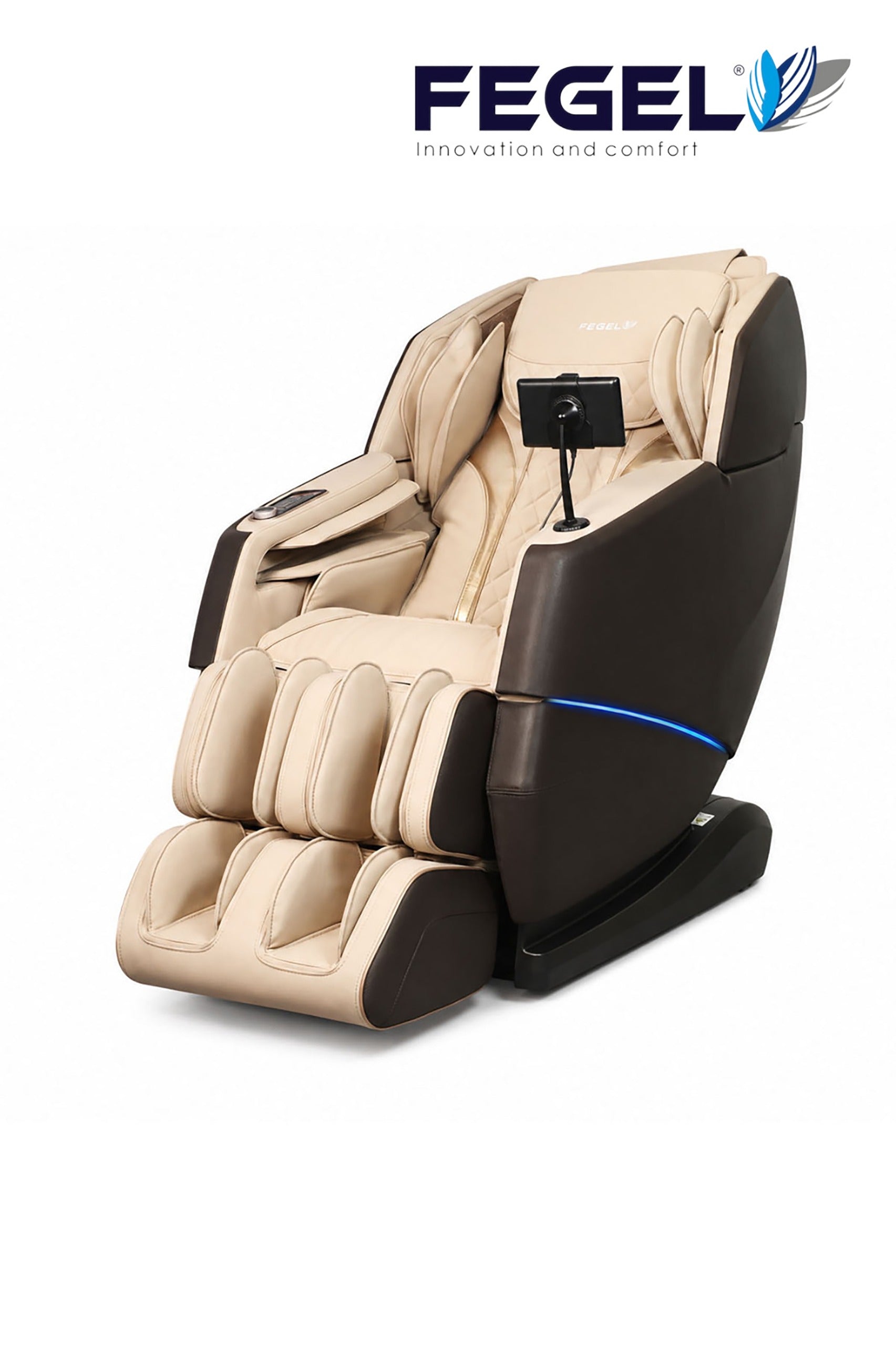
- FG-700 — for narrow living rooms and technology lovers. With its Zero Distance design, it is positioned almost flush against the wall with 16 programs, a 7-inch touch screen, a 1300 mm SL rail, foot roller and automatic leg extension. The most comprehensive model.
If the budget is not enough: portable models
Let's set expectations clearly here — portable units are not the mini versions of massage chairs. They are devices that attach to your existing chair with a strap, focusing on the back and lower back areas. There is no Zero Gravity, SL rail, or full-body air cushion.
- FG-C43 — neck, back (upper/lower/full), lower back and hip massage; 3-stage vibration, air pressure, heating. Car cigarette lighter cable in the box.
- FG-C22 — shiatsu kneading, 3 levels of vibration and heating. Back and lower back focused, a simpler alternative.
For a long-haul driver or someone sitting fixed in the office, these two devices really work. But if you are expecting a "massage chair experience," they may disappoint.
Frequently asked questions
Is a massage chair good for a herniated disc?
This is not a medical device, but a comfort product. It can reduce muscle tension and provide relaxation; however, someone with an acute herniation must consult their doctor before use. Mechanical pressure applied at the wrong time can worsen the condition.
Is electricity consumption high?
No. The models are between 100–200 W; a 20-minute session is equivalent to a few hours' consumption of a light bulb. The operating cost of a massage chair is practically not something to talk about.
How much space does it take up?
Classic models require a 30–50 cm gap behind. In the FG-700 with the Zero Distance feature, this is almost zero. Mark it out on the floor before taking the total area when reclined.
Is installation difficult, how many people are needed?
We are talking about weights between 64–97 kg; carrying and placing requires at least two people. The floor where the chair will be placed must be flat and solid.
How long is the warranty?
All Fegel massage chairs have a 2-year official distributor warranty.
If you are undecided between the models, answer two questions, and we will solve the rest together with you: how many cm of space is there behind where you will put the chair, and is your main expectation from the massage relaxation or pain management? You can review all models in the massage chair category.