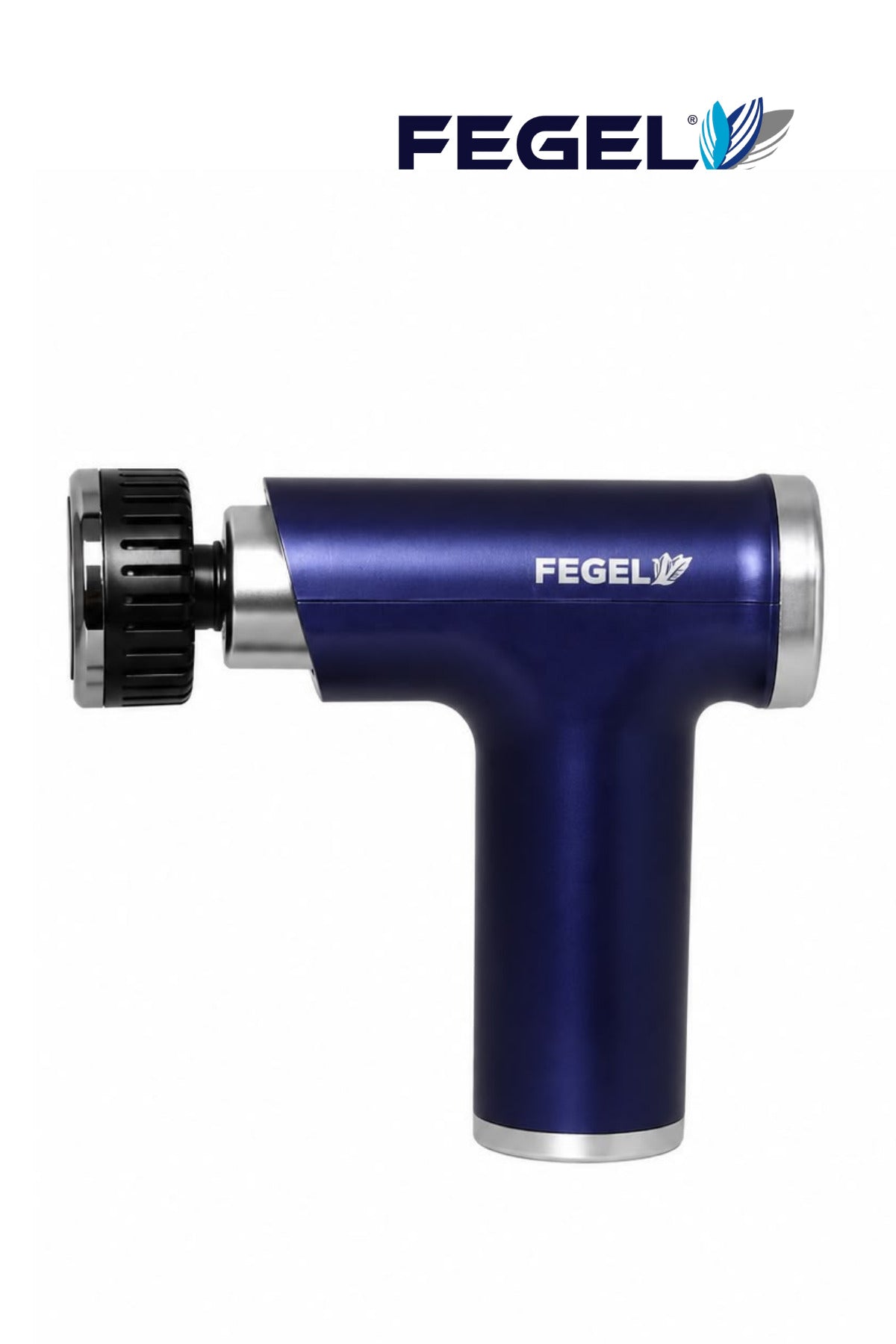
The most common mistake people make with massage guns is using them like pain relievers. Finding a sore spot and leaving it there for minutes usually doesn't help; it often leaves you more sensitive the next day. The right way to use it is with surprisingly little pressure and a surprisingly short duration. In this article, we explain which attachment goes where, which areas to avoid completely, and why a session should not last more than 15 minutes.
First, the mechanism: what exactly does this device do?
A massage gun applies short, deep percussive strokes to muscle tissue by rapidly thrusting the attachment back and forth dozens of times per second. Two things happen: blood flow to the area increases, and the muscle's tension reflex temporarily decreases. The result is muscle relaxation and a temporary increase in range of motion.
Let's also say what it doesn't do, because managing expectations is important: it doesn't burn fat, treat cellulite, heal herniated discs, or repair injuries. It is a comfort tool for muscle fatigue, stiffness, and post-workout soreness—not a therapeutic device.
What does rpm mean?
rpm indicates how many strokes the attachment delivers per minute. Higher rpm is not always better; the functions are different:
- Low rpm (around 1800–2200 rpm) — for warming up, sensitive areas, older users, and first-time use. It penetrates deeper and is less uncomfortable.
- Medium rpm — for general relaxation and post-workout recovery. This is where most daily use happens.
- High rpm (3000 rpm and above) — for short pre-workout activation. It should not be used for long periods.
For example, our FG-780 model operates in the 1800–3200 rpm range ; that is, both gentle warming and short activation are possible with the same device. The FG-60 offers 9 intensity settings.
Which attachment goes where?
The attachments included in the box are not random; each one's contact surface is designed for a different tissue. The wrong attachment can turn a good device into a bad experience.
- Ball / muscle ball (round, soft) — the general-purpose attachment; use this if you're not sure. Large muscle groups: thighs, glutes, calves, and back muscles. It spreads the pressure over a wide area.
- Flat / flat disc — medium-sized muscle groups and areas near the bone. It is more controlled and less piercing than the ball. It is suitable for the chest and shoulder area.
- Fork / double ring (U-shaped) — for the sides of protrusions such as the spine and Achilles tendon. While the two ends contact the muscle, the middle gap passes over the bone. It should never touch the spine itself.
- Needle-tipped (pointed) — for a single trigger point, the palm of the hand, or the sole of the foot. It is the most aggressive attachment; use it briefly, on a low setting, with light pressure. Beginners should not start with this attachment.
- Spoon / curved tip — an attachment that wraps around body contours and adapts to large muscle surfaces.
- Heated attachment — speeds up the warming of cold muscles, makes a noticeable difference for morning stiffness and use in cold weather. It is available on our FG-60 and FG-711 models.
The number of attachments is not an indicator of quality, but of versatility. The FG-60 and FG-780 come with six attachments each; the foldable FG-2024 includes five: needle-tipped, double ring, UV facial, UV curved, and classic muscle ball.
Correct use: contact, not pressure
The classic mistake is pressing the device into the muscle. The device itself provides the percussion; pressing it strains the motor, reduces the stroke length, and decreases the effect. The correct way is:
- Turn on the device and start on the lowest setting. Increase the setting after it touches the muscle—do not set it to a high setting while it is in the air and then strike the muscle.
- Apply only as much pressure as the device weighs. Do not push it with your hand ; simply hold it.
- Do not stay in one place; move it. Move along the muscle at a speed of approximately 2–3 cm per second. Staying in one spot causes bruising and sensitivity.
- Move along the muscle, not across it. Follow the direction in which the muscle fibers run.
- Stop if you feel pain. The goal is a "deep but tolerable" sensation; sharp pain is a warning.
How long?
Much shorter than you might expect:
- Single muscle group: 1–2 minutes. 30 seconds is enough for small muscles.
- Total session: 5–15 minutes. Our FG-60 user manual also recommends 5–15 minutes per muscle group in a single session.
- Pre-workout: high setting, short duration (30–45 seconds), for activation.
- Post-workout: low-to-medium setting, 1–2 minutes, for relaxation.
"If I use it longer, I will relax more" is incorrect. Prolonged use can cause micro-irritation in the tissue and increased pain the next day.
Where not to use it? — Do not skip this section
The areas where a massage gun should not be used are clear:
- The front and side of the neck — the carotid artery and carotid sinus are located here. For the neck, use only the back muscle groups, on a low setting.
- The head, face, and skull.
- Bone protrusions such as the spine, shoulder blade, kneecap, elbow, and ribs — use it on the muscle itself, not the bone.
- The abdominal area and over internal organs.
- Varicose veins, enlarged veins, open wounds, new bruises, fractures/cracks in the area, or surgical scars.
- Swollen or inflamed joints — cold therapy is required for acute injuries, not percussion.
Those who should consult a doctor: pregnant women, those with a pacemaker or other implanted devices, those taking blood thinners, and those diagnosed with osteoporosis, deep vein thrombosis, advanced diabetes, or neuropathy. These devices are not medical devices and cannot be used for therapeutic purposes.
What to look for when choosing a device
- Weight — you will be holding your arm up for 10 minutes. Devices under 500 grams make it easier to reach your back with one hand; for example, the FG-711 weighs 471 grams. Heavier devices are generally more powerful, but they are harder to use on your own back.
- Battery — a battery in the 1800–2000 mAh class will last for several sessions with typical use; the FG-780 runs continuously for approximately 2 hours on a single charge. The battery in the FG-2024 is replaceable, a detail that determines the device's long-term lifespan.
- Noise — if you plan to use it in the living room in the evening in front of the television, a model with a quiet motor (such as the FG-95) will noticeably increase daily use.
- Portability — if you plan to take it to the gym, the foldable body (FG-2024) really saves space in a bag.
- Heating — makes a difference in cold weather or for morning stiffness; it is available on the FG-60 and FG-711.
Maintenance and safety
- Snap the attachment firmly into place. A loose attachment will make noise and may fly off while in use.
- Do not use it while charging. This is a manufacturer's warning for both battery health and safety.
- Wipe the attachments with a damp cloth; do not immerse them in water. Parts that come into contact with the skin must be kept clean.
- Do not leave the device in direct sunlight or in a vehicle at high temperatures ; lithium batteries do not like heat.
- If you will not use it for a long time, do not leave the battery completely empty, but half full.
Summary
Hold it lightly, move it, keep it brief, and stay away from bones. The ball attachment and a low setting are always the right choice for beginners; use the needle-tipped attachment only after you have become familiar with the device. When used correctly, a massage gun is a simple tool that makes a noticeable difference the next day when climbing stairs—but when exaggerated, it becomes a tool that increases pain.